Who is PSPC and what does RPB do
Public Services and Procurement Canada manages a massive federal portfolio and leads major builds and retrofits. Its Real Property Branch (often labeled Real Property Services) runs projects and specifications that shape which materials make the cut. PSPC reports a 59.9% reduction in GHG emissions for its Crown‑owned building portfolio in 2022–2023 versus a 2005 baseline (PSPC Departmental Plan, 2025).
IDP in a nutshell for federal work
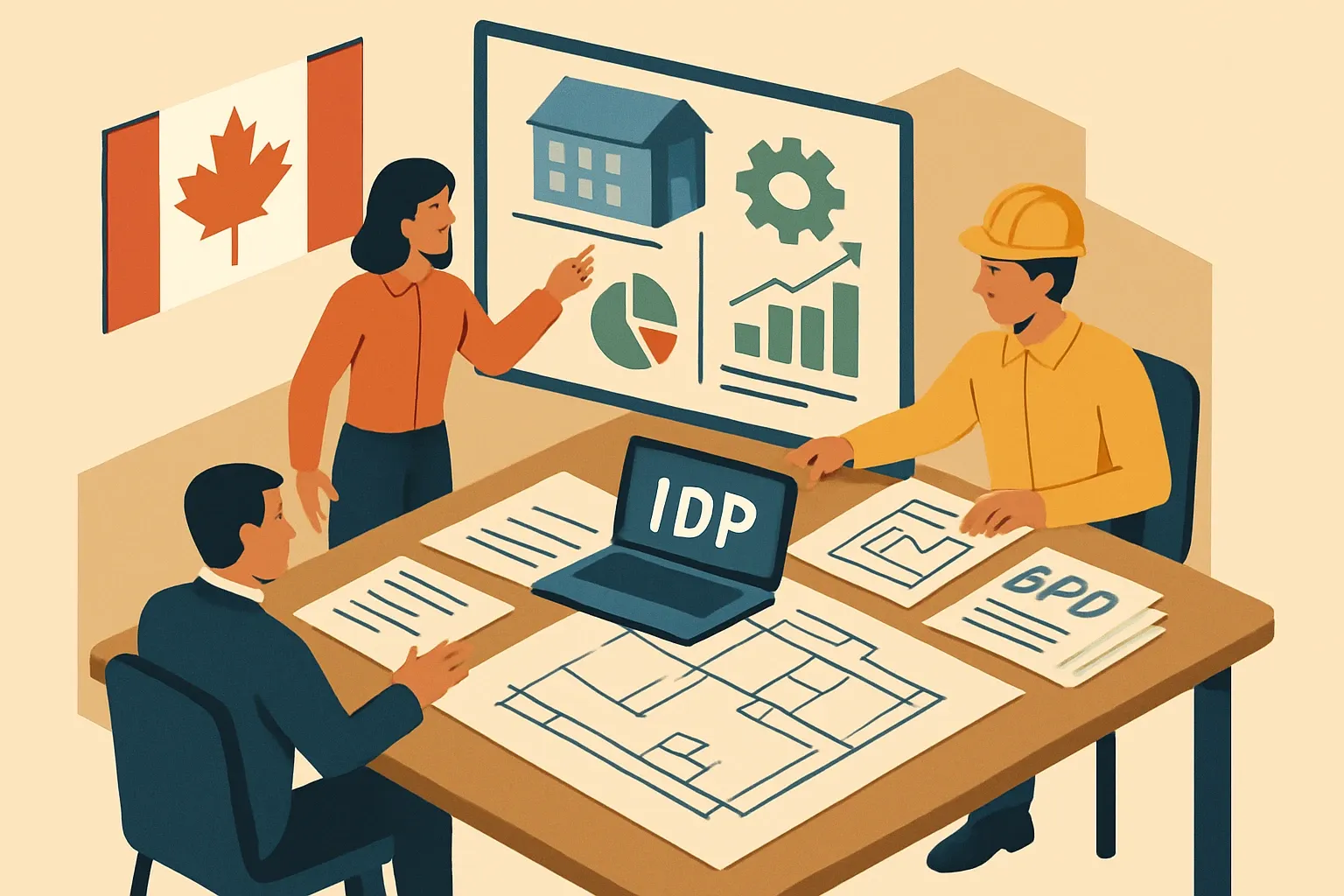
The Integrated Design Process is a team sport. Owners, designers, cost, operations, and suppliers meet early to set targets, test options, and lock decisions before drawings snowball. Think of it as a series of focused charrettes where data replaces guesswork.
The embodied‑carbon rules IDP must hit
Canada’s Greening Government Strategy requires whole‑building LCAs by 2025 at the latest for major projects and a 30% reduction in embodied carbon starting in 2025 (Greening Government Strategy, 2024). Treasury Board’s standard also requires disclosure and at least 10% lower‑carbon concrete, applying to projects over $10M that use more than 100 m³ of concrete (Contracting Policy Notice 2022‑3, 2022). In July 2025, the standard expanded to require whole‑building LCA use in design optimization and added requirements for structural and reinforcing steel (Contracting Policy Notice 2025‑6, 2025).
Proof that disclosure is real, not theoretical
PSPC reports that 100% of its major construction projects disclosed embodied carbon for structural materials in 2024–2025, enabled by mandatory tracking in design and construction contracts (PSPC DSDS, 2025). If your product lacks an EPD, teams default to generic factors that often look worse than your measured reality.
Want to secure more federal projects in Canada?
Follow us on LinkedIn for insights on EPD compliance and strategies to ensure your materials get specified more often.
Where EPDs slot into IDP
Early. During goal‑setting and concept design, whole‑building LCA models need credible product data. Third‑party‑verified EPDs give teams confidence to pick your mix, resin, panel, coating, or steel profile when they’re balancing cost and carbon. No EPD usually means a penalty in the model, which quietly nudges you out of the spec.
What to bring to the first charrette
Arrive with clean plant‑level utility data, production volumes, transport distances by mode, and any process fuels. Have current product‑specific EPDs, mill certs where relevant, and alternates the team can swap in live. Include practical constraints like lead times and minimum order quantities. Show options, not only ideals, so cost consultants can price them in the room.
Getting concrete and steel ready for questions
For concrete, be ready with mix designs, SCM ranges, curing methods, and EPDs tied to the plant that will supply the job. For steel, align to the updated standard by preparing EPDs for sections, plate, and rebar where possible and clarify recycled content and melt route details. These specifics let the LCA lead hit the 30% reduction target without design gymnastics.
Specs that actually stick
IDP outcomes feed the basis‑of‑design and spec language. If your documentation matches those targets, procurement can reference your EPD IDs cleanly and evaluators can verify submittals fast. That shortens review cycles and reduces substitution risk. It also means fewer last‑minute RFIs that chew up everyone’s time.
Timing, renewals, and portfolio planning
Map your EPD update cycle to anticipated federal RFPs so validity never becomes a late‑stage question. If a product line is changing, signal what’s stable versus evolving so the team can model both. Reliable cadence beats heroic sprints, every time.
Pick partners who do the heavy lift
IDP rewards teams who show up with complete, auditable data. Choose LCA support that can chase enviromental inputs across plants, wrangle references to the right PCRs, and publish with the operator your client prefers. White‑glove data collection keeps your engineers focused on making better products while the paperwork gets done right.
The takeaway for manufacturers
Federal Canada is clear on direction and numbers. Whole‑building LCAs, real disclosure, and measured reductions are baked into procurement. If you prepare for IDP like it’s the main event, with EPDs and plant data in hand, you move from “maybe” to “designed‑in” long before tender. That is where specs are truly won.