What AB 43 actually does
AB 43 updates California’s embodied carbon plan by authorizing the Air Resources Board to set up an embodied carbon trading system and to integrate it with the existing AB 2446 framework. CARB’s embodied carbon program targets a 40 percent net greenhouse gas reduction from building materials by 2035, with rulemaking underway now (CARB Embodied Carbon program, 2025) (CARB, 2025).
Where rulemaking stands today
CARB is building the reporting backbone first, which is the foundation any trading would sit on. Staff held an Embodied Carbon Reporting Technical Meeting on October 30, 2025, with written comments open until December 8, 2025 (CARB Embodied Carbon Meetings, 2025). The chaptered AB 43 gives CARB permission to build a trading market but does not force a launch on a fixed date.
How a trading system could work on your jobsite
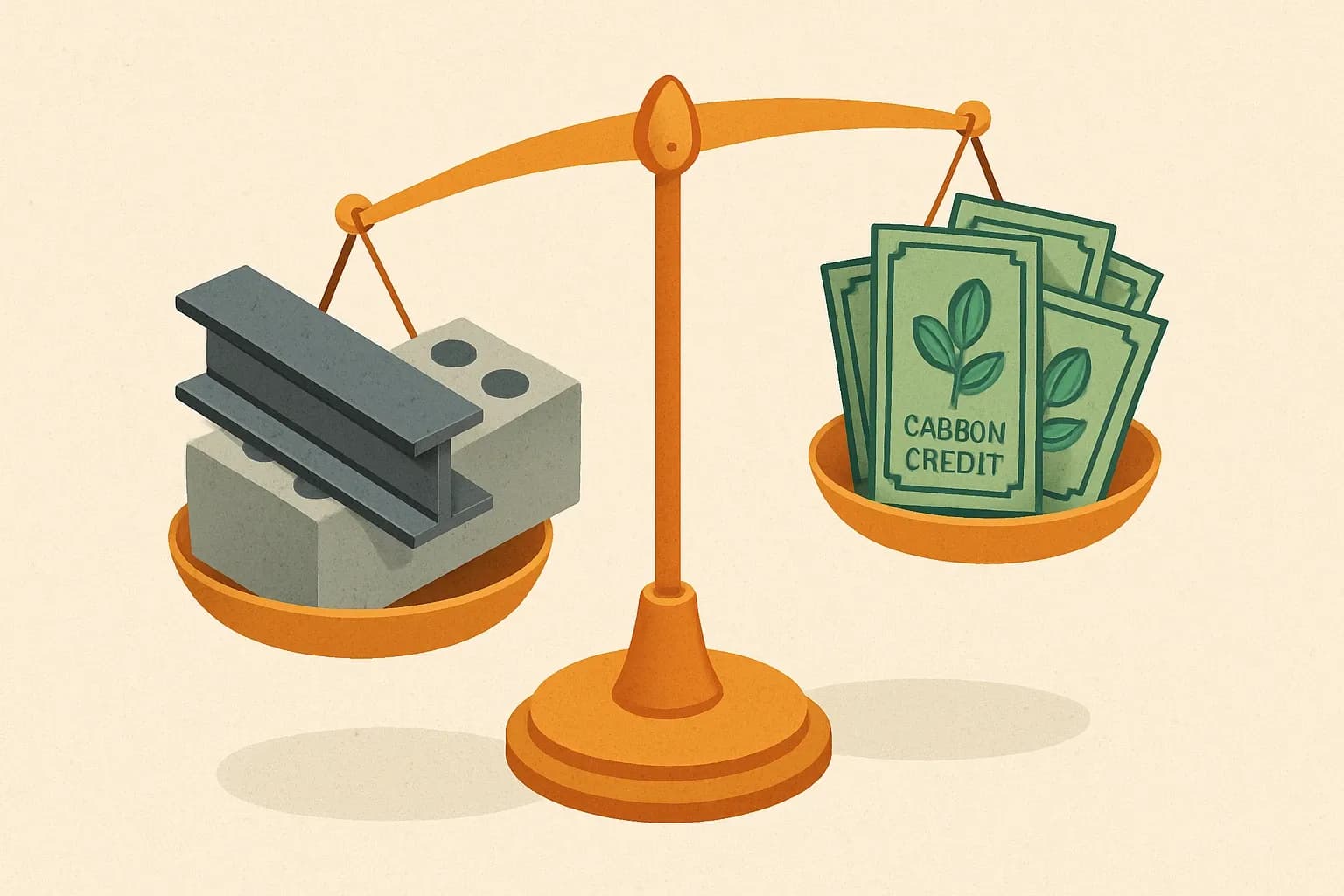
Think of it like a league table for carbon intensity. Projects that beat a target earn credits. Projects that miss buy credits. Materials data flows from EPDs into project carbon accounting, then into a registry that tallies performance. No trustworthy EPDs means no proof, which means fewer credits and higher costs.
CALGreen is already moving the market
California’s building code started requiring lower embodied carbon concrete on large nonresidential projects and schools on July 1, 2024. Thresholds are 100,000 square feet for most state‑regulated nonresidential buildings and 50,000 square feet for DSA‑jurisdiction schools, with the nonresidential threshold scheduled to drop to 50,000 square feet on January 1, 2026 (DGS CALCode Quarterly Spring, 2025) (DGS CALCode Quarterly, 2025). For projects in scope, compliance paths include whole‑building LCA, product‑specific GWP targets, or weighted‑average concrete mixes (CalCIMA, 2024) (CalCIMA, 2024).
Are you ready for embodied carbon regulations?
Follow us on LinkedIn for updates that help you stay compliant and competitive in your projects.
Why EPDs are the currency
Trading depends on auditable numbers. Product‑specific, third‑party verified EPDs turn plant data into project‑ready CO₂e per unit. That is the metric procurement teams will clear against targets. Without it, specifiers must use conservative defaults that make your product look heavier than it is, which quietly pushes it out of contention.
What to prepare, fast
- Map SKUs to the right PCRs and program operators so every high‑volume product has a current, product‑specific EPD.
- Tighten primary data capture for the chosen reference year across energy, fuels, yield losses, and transport. The cleaner your inputs, the better your GWP number.
- Stand up a process to refresh EPDs before major pursuits, and to generate mix‑specific or facility‑specific cuts when a bid requests it.
These steps help teams recieve credits instead of buying them.
Dates and targets that matter
- 40 percent net GHG reduction goal for building materials no later than 2035 sets the direction for targets and any crediting baseline (CARB Embodied Carbon program, 2025) (CARB, 2025).
- CALGreen embodied carbon requirements are in force for large projects and tighten again on January 1, 2026, when the nonresidential threshold drops to 50,000 square feet (DGS CALCode Quarterly Spring, 2025).
- California’s broader carbon market has been extended to 2045, reinforcing long‑term market signals for carbon pricing in the state economy (ICAP, 2025).
What we still don’t know
CARB has not finalized credit allocation, price guidance, or trading periods. Earlier drafts discussed potential timelines, but the chaptered bill leaves launch timing to CARB. Expect alignment with project‑level reporting so credits are backed by the same data structures used for code compliance.
Commercial upside
EPDs shorten due‑diligence for buyers and de‑risk bids that must hit embodied carbon caps. On projects subject to CALGreen pathways or city rules, an EPD can be the difference between earning credits and paying for them. That tends to speed decisions, cut substitutions, and protect margins.
The move now
Get your product‑specific EPDs in place, centralize data collection so updates are quick, and monitor CARB’s workshops to anticipate any category‑specific targets. When trading arrives, the teams with clean EPDs, tidy data, and practiced reporting will set the pace, not chase it.