EPDs in Czechia, in a nutshell
An Environmental Product Declaration follows EN 15804 and is third‑party verified. Czech buyers accept EPDs from established European program operators that align with ECO Platform rules, so you do not need a uniquely “Czech” EPD. English EPDs are common and adding a Czech PDF layer helps in municipal bids.
Where Czech EPDs usually get published
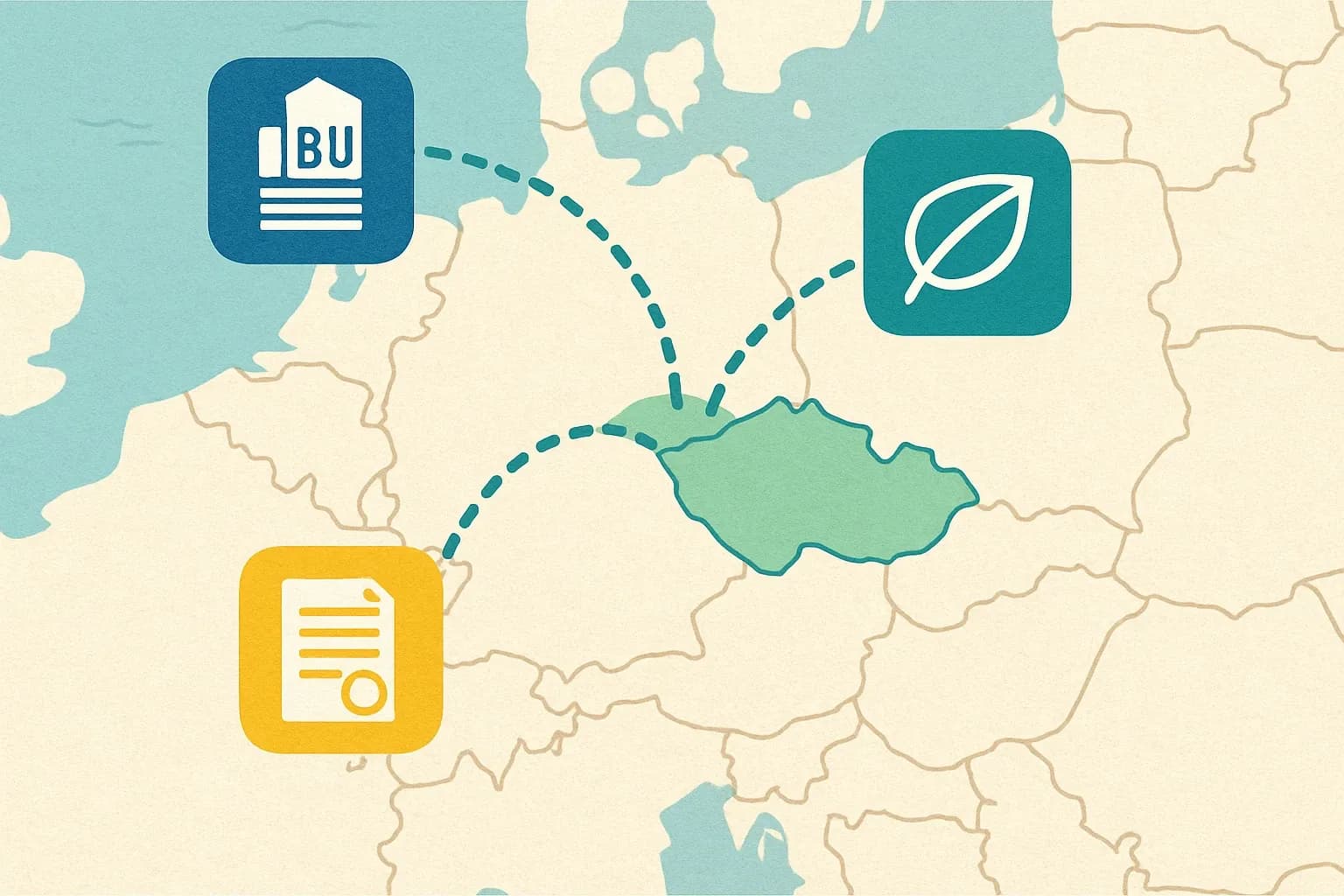
Most manufacturers in and around Czechia publish with IBU, The International EPD System, ITB Poland, or EPD Norway. ECO Platform lists IBU at 2,565 EPDs and The International EPD System at 12,749 EPDs as of July 1, 2025, which signals broad recognition across the EU (ECO Platform, 2025) (ECO Platform, 2025).
Do public buyers care
Public procurement is about 15% of EU GDP, so tenders are a large sales channel where documentation moves markets (European Commission, 2025) (European Commission, 2025). In the latest published indicators for Czechia, 81% of procedures are still awarded to the cheapest bid, well above the EU average of 56%, which means clear technical qualifiers like EPDs can be decisive before price comes into play (European Commission Single Market Scoreboard, 2025) (European Commission Single Market Scoreboard, 2025).
The rulebook behind your numbers
Every EPD must follow a Product Category Rule. For most Czech construction products there is no need to author a new PCR. Teams typically mirror the PCR competitors already use, then check version timelines and where the EPD will be published. A PCR is the rulebook of Monopoly. Ignore it and the game falls apart.
Regulatory backdrop to watch
The new EU Construction Products Regulation was adopted in 2024 to replace 305/2011 over time. It does not mandate EPDs across the board, yet it strengthens information flows around product performance. Separately, EU institutions approved a two‑year delay for the second and third waves of CSRD reporting in 2025, which shifts some sustainability reporting work to 2028 and 2029 for affected filers (Council of the EU, 2024). This does not change buyer requests for EPDs in projects today.
Want to win more tenders in Czechia?
Follow us on LinkedIn for insights on how EPDs can unlock opportunities and improve your project specifications.
What data Czech manufacturers actually need
Pick a recent 12‑month reference year and gather utilities, fuels, raw and recycled inputs, packaging, yields, scrap, and outbound logistics to typical Czech or EU customers. For brand new products, a prospective EPD can start with at least three months of production data, then update once a full year is available. Keep supplier Environmental Footprint or EPD data where possible to avoid generic penalties.
Operator choice and languages
Choose a program operator recognized through ECO Platform so your EPD travels across EU tenders. IBU, Environdec, ITB, and EPD Norge all support EN 15804 and multilingual PDFs. Fees and templates vary by operator, so plan formatting and translation early. We prefer to select the operator that best matches your market routes and PCR landscape, not the other way around.
Tender strategy that fits Czech habits
With many awards decided on lowest price, the smart move is to turn the EPD into a spec gate instead of a brochure. Provide a clear, project‑ready EPD so buyers can do carbon accounting without default factors that penalize your product. That keeps you comparable and prevents overspecifying on price only.
Local norms that often trip teams up
Secondary materials are growing. If you market recycled content, align your claims with Czech waste legislation and the evolving EU Construction Products Regulation to avoid inconsistencies in EPD text and DoP material. The Ministry of Industry’s guidance references both the “old” and “new” CPR, which is a good compliance compass for building products made from waste streams (MPO, 2025).
How long does it take, really
Calendar time depends on how fast operational data arrives. The heavy lift is coordinating plants, ERP pulls, and supplier inventories. A ruthlessly managed data‑collection sprint is what determines speed. Publishing then is usually measured in weeks once verification is greenlit. Done right, the EPD pays back quickly because it keeps you in specs you might otherwise miss.
What to do next
Confirm which PCR your closest competitors use, pick a program operator acceptable across Czech and EU tenders, line up a clean 12‑month data set, and plan translations. If that sounds like a lot, it is. The work should live with a partner who removes the internal chasing so your team stays on production and product. That is how EPDs stop feeling like paperwork and start functioning as a sales asset. It is definately doable.