The German EPD landscape in one view
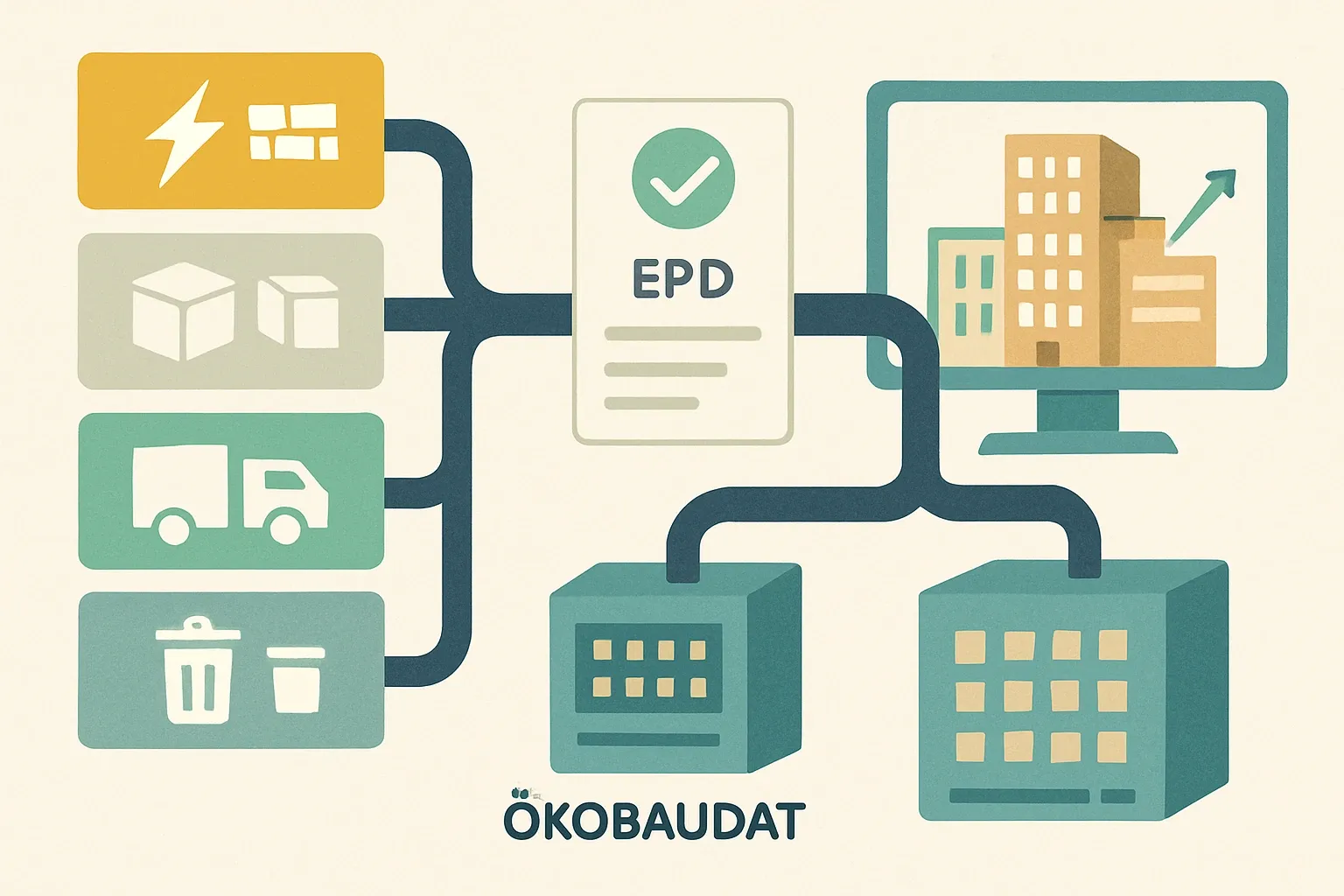
Germany runs on EN 15804. Most construction EPDs are verified under that standard and many are published through Institut Bauen und Umwelt e. V. (IBU), whose database lists over 210 member companies and more than 1,800 published EPDs today (IBU, 2025) (IBU, 2025). Those declarations feed project LCAs through ÖKOBAUDAT, the federal database operated by BBSR.
ÖKOBAUDAT accepts EPDs from a short list of recognised programme operators and checks conformance before data goes live. Data is provided as PDF for humans and XML for machines, which keeps design tools and the federal eLCA workflow in sync (BBSR guidance).
Why ÖKOBAUDAT matters for bids
DGNB and the federal BNB system pull from ÖKOBAUDAT. If your EPD is not compatible, project teams default to generic or penalized factors and will often skip the product. An ÖKOBAUDAT‑compatible XML removes that friction and lets your actual impacts show up in the building model.
A new ÖKOBAUDAT release typically happens about once a year, while recognised operators can submit smaller updates continuously. That cadence means well prepared manufacturers can still get in mid‑cycle without waiting a full year for visibility (BBSR guidance).
QNG funding and how EPDs plug in
Germany’s QNG quality label sits on top of DGNB or other registered systems and unlocks access to BEG funding in defined cases. The introductory phase ended on 31 May 2024, which tightened registration rules for assessment systems and bodies (QNG, 2024) (QNG, 2024). For manufacturers, the practical takeaway is simple. Verified, EN 15804‑based EPDs that are usable in building LCAs help project teams hit QNG LCA requirements without detours.
EN 15804 details that actually change your work
Think of a PCR as the rulebook of Monopoly. Ignore it and the game falls apart. In Germany, EN 15804+A2 indicators are the reference in mainstream certification and database workflows. Older A1 results are not comparable at indicator level in ÖKOBAUDAT, so avoid mixing them in building models (BBSR search notes, 2024).
Validity usually runs five years. Programme rules vary, yet the typical window remains five years from verification or publication, with updates needed if results change materially by about 10 percent (EPD International FAQ, 2025). Time your launch so renewal does not collide with your busiest bid season.
Who publishes EPDs in Germany
IBU is the dominant programme operator and a member‑based association. In 2024, IBU reported 533 single EPDs plus over 300 tool‑generated EPDs for more than 840 EPDs published that year, and over 4,700 total since 2012, showing steady demand across product types (IBU, 2024) (IBU, 2024). Other operators accepted by ÖKOBAUDAT include Bau‑EPD GmbH, ift Rosenheim, Kiwa Ecobility Experts, European Aluminium and Dachverband Lehm, among others (BBSR guidance).
Ready to unlock the German market with EPDs?
Follow us on LinkedIn for insights that help you navigate regulations and win projects in Germany.
“EPD Germany” checklist for manufacturers
A quick gut‑check before you start avoids weeks of rework.
- Operator fit. Confirm the programme operator is accepted by ÖKOBAUDAT and can deliver XML without custom scripting.
- PCR alignment. Use the same PCR your competitors use unless there is a strong reason not to. That keeps apples with apples in buy‑side comparisons.
- Background data. Germany hosts datasets based on Sphera MLC and ecoinvent. Both are usable when the operator and formatting rules are met. Document the choice.
- Plant scope. Decide if you need a single‑plant, multi‑plant, or tool‑generated approach. Tool routes can scale SKUs quickly but still require robust governance.
- Review timeline. Build in time for third‑party review and for ÖKOBAUDAT conformance checks so your data does not miss a bid window.
How German rules shape your ROI story
Project teams have to hit carbon and LCA targets in DGNB and public projects. Without a product‑specific EPD they fall back to generic factors with conservative assumptions. That is like playing a video game on hard mode from level one. A verified, current EPD lets your real performance count and reduces the risk of being swapped late in design because a rival product’s numbers slot straight into the model.
The cost of a solid EPD is often earned back by a single mid‑sized win. The bigger saving is time. Sales can pursue QNG‑or DGNB‑driven projects immediately instead of waiting months for paperwork to catch up.
Data collection in Germany, done without the scramble
German plants tend to have strong utility metering and ERP data. The trick is gathering it once, cleanly, across energy, materials, packaging, waste and transport for a defined reference year. A good partner will run the white‑glove data pull, reconcile gaps with finance and operations, and keep a tidy audit trail ready for the verifier. That is how EPDs arrive fast and error‑free, not with inbox ping‑pong that makes engineers want to trow their laptops.
Common pitfalls we see teams make
Publishing only a PDF. Teams discover too late that their declaration is not structured as ÖKOBAUDAT XML. Fixing it burns calendar time at the worst moment.
Mixing A1 and A2 results. Do not paste non‑comparable indicators into one LCA. Reviewers catch it and it confuses designers.
Waiting on a perfect dataset. If the plant has at least a full year of production data, move. Prospective EPDs are possible for brand‑new lines, then updated after a year.
Smart publishing cadence
Time the publication to avoid a renewal cliff during a known product launch or budget freeze. Keep a light annual check on energy mixes and key materials. If anything shifts enough to move indicators materially, plan an interim update rather than waiting for the five‑year mark (EPD International FAQ, 2025).
Where to start this quarter
Pick one hero product per category. Confirm the operator route to ÖKOBAUDAT. Align PCRs with the competitive set. Lock the reference year and the plants. Then let a partner handle the heavy lift on data and verification so your team can stay focused on production, specification work and customers who are ready to buy.
Numbers to keep in your back pocket for stakeholder briefings. IBU lists 210 plus members and 1,800 plus live EPDs in its database today (IBU, 2025) and logged more than 840 new EPDs in 2024 alone, with 4,700 plus published since 2012 (IBU, 2024). QNG’s introductory phase ended 31 May 2024, which tightened eligibility of assessment systems and oversight of bodies that issue the label (QNG, 2024) (IBU, 2025 and IBU, 2024 and QNG, 2024).