EPDs in Finland, in plain terms
An Environmental Product Declaration is a third‑party verified summary of a product’s life‑cycle impacts that follows EN 15804 in Europe. In Finland, buyers expect credible, product‑specific data that plugs neatly into building LCAs. Think of an EPD as the passport your product shows at every design checkpoint.
Who actually publishes EPDs here
Manufacturers commonly publish with the Building Information Foundation’s RTS EPD program, EPD Hub, the International EPD System, IBU, or EPD Norge. All are recognized by specifiers in Finland. RTS is well known locally and offers Finnish or English publication. EPD Hub is digital‑first and active across Europe. Environdec, IBU, and EPD Norge are also familiar to Nordic clients.
The rules your EPD must follow
EPDs for construction products in Finland align with EN 15804+A2 and ISO 14025. Validity is typically five years across programs (RTS EPD FAQ, 2025) (RTS EPD FAQ, 2025). RTS also supports pre‑EPDs at 1.5 years when a product is new and production data is still ramping (RTS EPD Pricing FAQ, 2025). A PCR is the rulebook for your product category. The smart move is to select the PCR most competitors already use, unless a better‑fit alternative improves comparability.
What Finland’s Building Act changes in 2025–2026
The new Building Act introduces a climate report and a building component list for many new buildings starting January 1, 2026. The method is based on EN standards and Level(s), and national threshold values are in preparation (SYKE, 2025) (SYKE, 2025). Several cities are already moving faster. Helsinki applies a limit value for multi‑storey apartment buildings, currently 14.0 kgCO2e per m² per year over a 50‑year period (City of Helsinki, 2024) (City of Helsinki, 2024).
Want to navigate EPDs in Finland effectively?
Follow us on LinkedIn for insights that help you secure compliance and win more projects.
National emissions database vs product EPDs
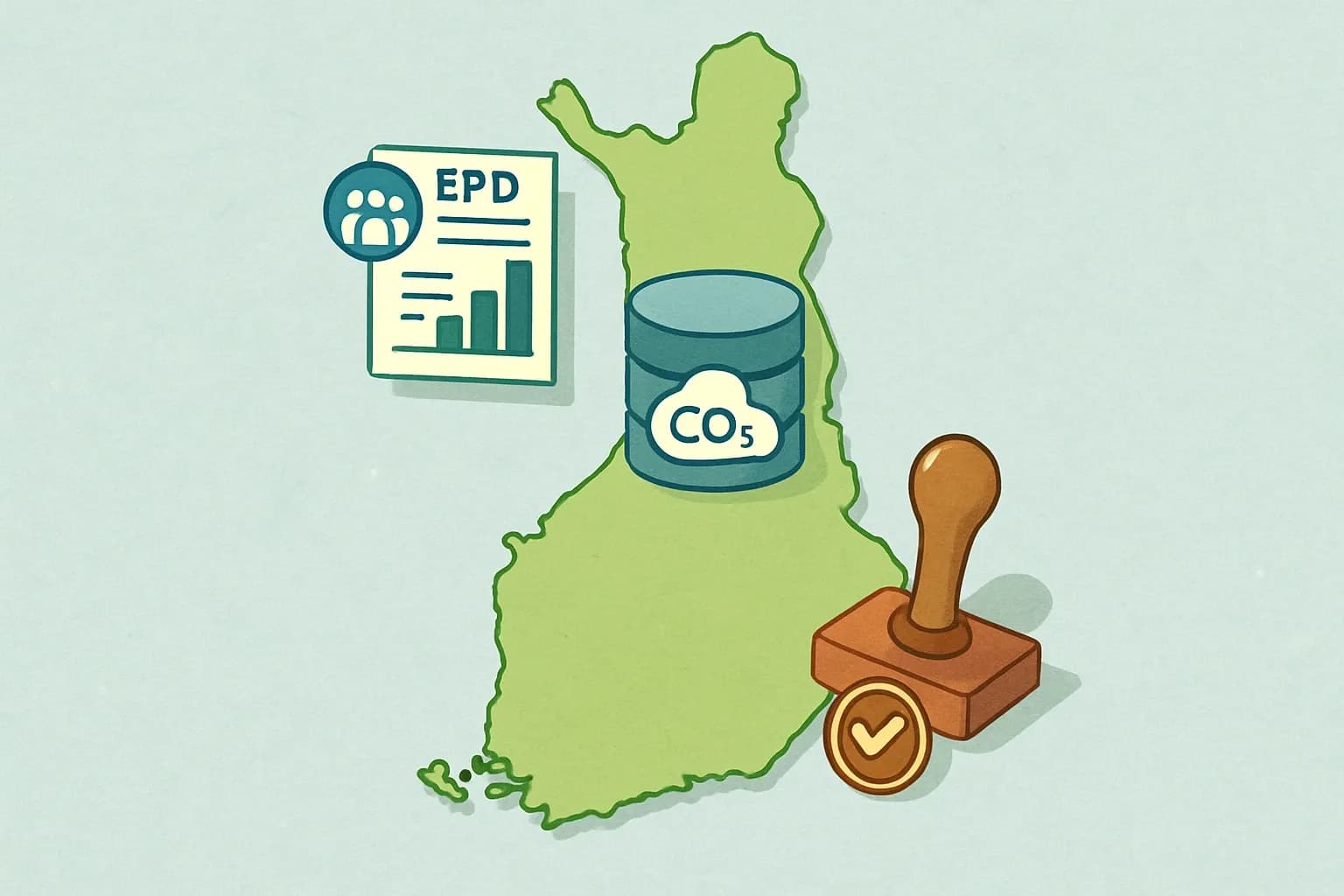
Finland’s CO2data service provides average emission factors for common building products. It supports comparable LCAs for permit‑grade climate reports, but it does not host individual EPDs. That matters because generic values can be conservative compared to a proven product‑specific EPD (Ministry of the Environment and SYKE press release, 2025). Bring an EPD and you let the design team model your true performance instead of a blunt average.
Where your EPDs get found
Designers and assessors look in operator libraries and in project tools. For Finland that typically means the RTS EPD database, EPD Hub’s library, Environdec, IBU, and EPD Norge. Publishing in English or Finnish covers most needs. Secondary publishing across Nordic operators is possible for visibility without re‑work, subject to each operator’s rules.
A quick playbook for 2026 permit readiness
- Map your top 20 revenue‑driving SKUs used in Finnish buildings. Prioritize high‑mass or frequent items first.
- Pick the prevailing PCR and operator for each category. Align with local expectations to avoid verifier ping‑pong.
- Lock a clean data year. Gather energy, materials, waste, and transport with site teams. For brand‑new lines, a pre‑EPD can bridge the gap until a full year of operations is available.
Verification, languages, and practicalities
EPDs must pass third‑party verification. RTS maintains a list of approved verifiers and publishes in English or Finnish, with translations allowed. EPD Hub and others use similar guardrails. Expect to update if inputs shift meaningfully. Most operators trigger re‑review when results change by about ten percent on core indicators, which keeps enviromental claims honest.
Commercial upside you can measure
Public clients and many private developers are steering toward low‑carbon designs, and Finland’s permit‑level climate report hardens that direction. A current, comparable EPD removes friction when a project’s LCA needs proof, which means your product stays in the conversation on merit rather than on price alone. We focus on making the data‑collection load light so your engineers keep building, not building spreadsheets.
Picking PCRs that match the Finnish landscape
If peers publish interior paints with an EN 15804 cPCR under RTS or Environdec, mirroring that choice helps apples‑to‑apples comparison in the building model. If your product sits between categories, evaluate whether a broader construction‑materials PCR captures reality without over‑generalizing. Also check expiry horizons. A PCR that rolls over soon may force earlier rework.
Tie it together
“epd finland” isn’t a single site or rulebook. It is a network of recognized operators, a clear set of European standards, a national emissions database for averages, and a Building Act that brings climate accounting into permits in 2026 (SYKE, 2025). Get your product‑specific EPDs in place, then let projects use them as the better datapoint. That is how compliance turns into an ongoing spec advantage.